We are proud to announce that Dr Kirstine Bell from the Charles Perkins Centre at The University of Sydney has been awarded the 2023 JDRF Dr Robert Goldstein Award for her notable contributions to type 1 diabetes (T1D) research. This is an internationally competitive award given to early career researchers who show great promise in […]
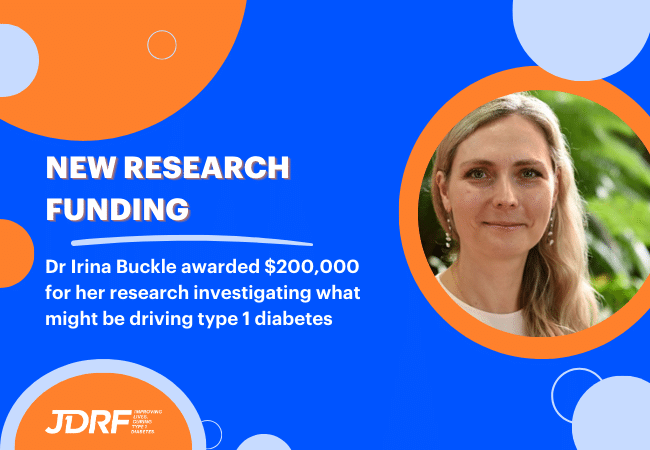
JDRF is proud to announce new funding of $200,000 (USD) to Dr Irina Buckle from Mater Research and The University of Queensland, to undertake a project which aims to understand what may be driving type 1 diabetes. Type 1 Diabetes (T1D) is a condition where certain types of immune cells, known as T cells, incorrectly […]
On Sunday 21 April 2024, a group of passionate cyclists are embarking on a wonderful fundraising initiative in memory of Sebastian Stafford, a cherished member of the type 1 diabetes (T1D) community. Amateur cyclists from all areas of life will be taking on a 130km hard cycle from Bella Vista to the breathtaking Bowral to […]
A research group from Norway has found that adding small amounts of glucagon to insulin speeds up its action. For people with type 1 diabetes (T1D) this would mean a faster acting insulin than what is on the market, and in turn, improved quality of life. The need for fast insulin T1D is an autoimmune […]
Earlier this month, our advocates and the JDRF team were in Parliament House for the exciting research announcement regarding funding committed for five research projects in collaboration with the ENDIA study. In addition to this they were able to meet with key decision makers and discuss the reality of type 1 diabetes (T1D) along with the importance […]
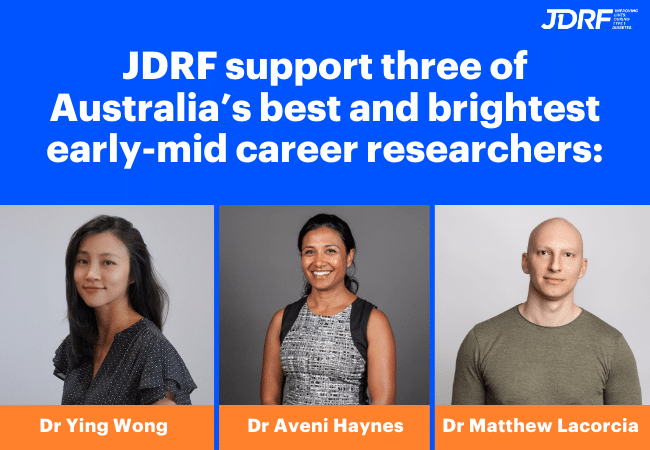
JDRF is delighted to announce that three Australian Early to Mid-Career Researchers (EMCRs) are being supported with over $2.2 million to continue their groundbreaking type 1 diabetes (T1D) research. JDRF is committed to nurturing the growth and impact of leading independent researchers who are instrumental in translating scientific discoveries to clinical applications. Dr Aveni Haynes […]
JDRF, the leading global type 1 diabetes (T1D) research and advocacy organisation, joins healthcare and humanitarian non-profits throughout the world in calling for a medical corridor to allow immediate access to lifesaving supplies and medicines, like insulin, needed by all people living with T1D in the Middle East conflict zone. At all times, including times […]
JDRF Australia and The Leona M. and Harry B. Helmsley Charitable Trust (Helmsley) have committed $3 million for research projects aimed at understanding how type 1 diabetes (T1D) develops, with the ultimate goal of preventing it. This is in collaboration with the Environmental Determinants of Islet Autoimmunity (ENDIA) Study. ENDIA is the world’s first T1D observational […]
Dougal has been living with type 1 diabetes (T1D) since the age of 4, a journey that began when he complained of sore legs. Despite the absence of any family history of T1D, Joanne (Jo), a health professional and parent, quickly recognised the signs, drawing on her expertise and a colleague’s experience as a T1D […]
We recently sat down with an incredible mother, Cara, who has experienced the profound journey of caring for her young daughter Mya, with type 1 diabetes (T1D). Cara shares her diagnosis story, offers valuable insights into managing T1D day-to-day, and explains why she signed up for One Walk to fundraise for JDRF. Her hope for […]
We could be one step closer to replacing the need for regular insulin injections in people living with type 1 diabetes (T1D), thanks to JDRF-funded Australian research that was published this week in the prestigious Nature journal. Why is this research important? During T1D development, the immune system mistakenly attacks the insulin-producing beta cells in […]
A JDRF-funded, world-first clinical trial has shown that a commonly prescribed rheumatoid arthritis drug (baricitinib) can preserve the body’s own insulin production and suppress the progression of type 1 diabetes (T1D) in those newly diagnosed with the condition. This comes after three decades of research out of the St Vincent’s Institute (SVI) in Melbourne, […]
JDRF has just funded a new Australian islet transplantation research project with the potential to revert type 1 diabetes. The benefits of islet transplantation Pancreatic islet transplantation is a life-saving and life-changing treatment currently available for people with type 1 diabetes (T1D) who are unaware of their dangerously low blood glucose levels (known as ‘severe […]
JDRF has funded a new Australian research project which may allow those with type 1 diabetes (T1D) to regenerate lost pancreatic cells. During T1D development, the immune system mistakenly attacks the insulin-producing beta cells in the pancreas. This leads to the loss and destruction of beta cells, meaning that people with T1D are no longer […]
The Australian Government’s Insulin Pump Program (IPP), administered by JDRF Australia, provides insulin pumps to young Australians up to the age of 21, living with type 1 diabetes (T1D), who meet certain financial and clinical eligibility requirements. The program supplies fully subsidised insulin pumps to people who would otherwise be unable to access insulin pump […]
A new study suggests that giving antivirals shortly after a type 1 diabetes (T1D) diagnosis may preserve the body’s ability to produce insulin. Recent results from a clinical trial published in the prestigious Nature journal have suggested that administering the antivirals pleconaril and ribavirin can preserve beta cell function in children and teenagers recently diagnosed […]
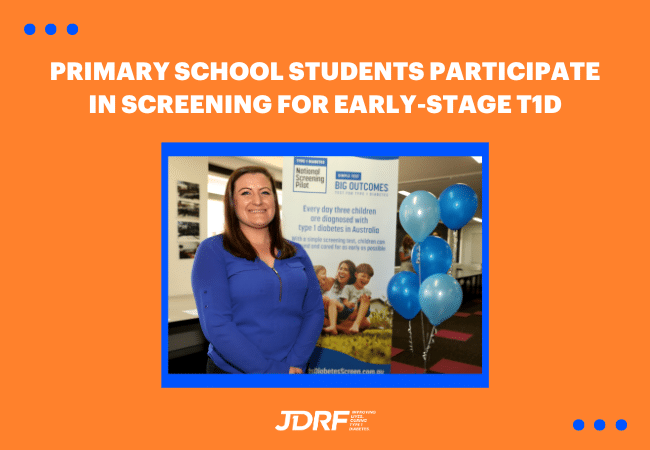
This World Diabetes Day, on Tuesday 14th November, students from kindergarten and year 4 at Inaburra School in Sydney’s south participated in screening to detect type 1 diabetes (T1D). This is part of the JDRF-funded Australian Type 1 Diabetes National Screening Pilot, a research project looking to identify early-stage T1D in childhood. It was the first […]
JDRF Australia has received an update from the Department of Home Affairs (DHA) regarding the guidelines for type 1 diabetes (T1D) technology and airport security and screening. This follows ongoing issues faced by community members when travelling through airport security with insulin pumps and continuous glucose monitors (CGMs). Advice varies for each specific device, but […]